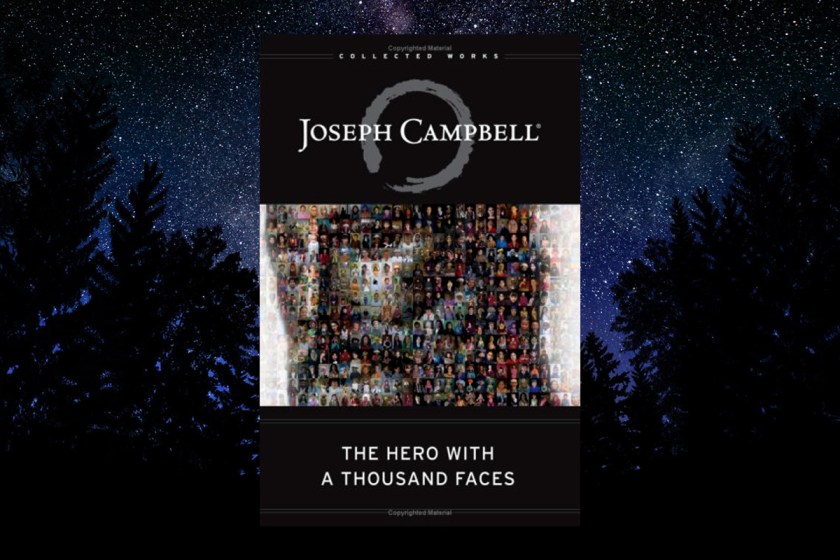
Joseph Campbell’s The Hero with a Thousand Faces is one of the most inspiring books I’ve ever read. Campbell is one of those rare thinkers whose perspective penetrates into the heart of my interests. Reading this book is like being his close friend and sharing his excitement. Campbell is a seeker exploring the unknown, mining past the surface of things to find the truth at their core. Through mythology, he provides insights into psychology, religion, philosophy, and the emotional journey of being a human.
Monomyth as Individuation
The Hero with a Thousand Faces is a non-fiction work of comparative mythology, exploring what Campbell terms the “monomyth” – an archetypal journey repeated through world mythology, religion, and other forms of storytelling. This monomyth takes the following shape:
“A hero ventures forth from the world of common day into a region of supernatural wonder: fabulous forces are there encountered and a decisive victory is won: the hero comes back from this mysterious adventure with the power to bestow boons on his fellow man.”1
Why is this journey claimed to be “universal?” Because it comes from the structure of the human psyche. This book wouldn’t be possible without Carl Jung, who was Campbell’s great inspiration. That being said, one of Campbell’s many talents is being a better communicator of Jungian ideas than Jung himself. The monomyth has universal potential because it traces the process of Jungian “individuation.”
Individuation outlines the psychological development of the individual, from fractured parts to a complete whole. First, a person must overcome internal demons, then integrate all sides of the personality into a whole, in order to finally become the Self the person is truly capable of becoming. This is done through the respiratory process of balancing light and dark conscious and unconscious forces, no longer being “at war” with oneself, and thus finding psychological wholeness. This becomes globally important, to both Jung and Campbell, since the wager goes: if the individual can find wholeness, then she will be able to bring wholeness to the entire world.
For a lighthearted overview of Campbell’s “hero’s journey” told through video games, check out this article I wrote for Kotaku last year.
What This Book Means to Me
Why do I like this book so much? First, it’s the tone. Campbell is a master of details, but never gets stuck on particulars. He is always interested in penetrating into the core of stories and ideas, just like a good psychoanalyst, to find the content that lies behind the symptoms. Campbell always wants to go deeper into the darkest depths of every moment. Such a journey is exhilarating. Second, it’s the new angle on familiar stories. Campbell presents famous myths in the light of their psychological content, revealing new insights in each connection. Thirdly, and most importantly, it’s the ideas.
Key Ideas for Being & Death
Campbell’s core ideas, as they pertain to Being & Death, are the following:
- The Power of Myth
- Campbell writes: “It has always been the prime function of mythology and rite to supply the symbols that carry the human spirit forward.”2
- Myth facilitates an understanding of internal psychological processes through external symbols. This is the very reason I make art – to know my own unknowns. The power of art, and myth, is to make conscious our unconscious content, and thus bring newness into the world.
- The Hero’s Journey
-
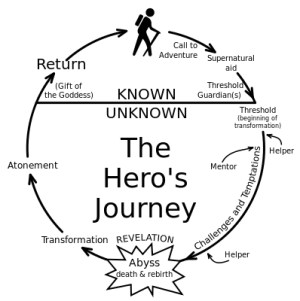
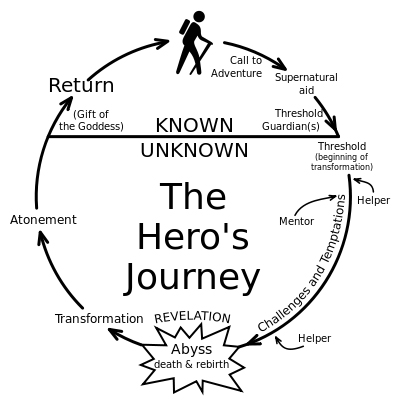
Diagram of the Hero’s Journey. Redrawn from Campbell’s original source on p. 210 by Wikipedia user Slashme in monomyth post.
- This speaks directly to the Void Mandala diagram. The hero’s journey is the journey from consciousness, into the dark unknowns of the Self, and then back again full circle toward a greater conscious awareness.
-
- Non-Difference
- Campbell writes: “Time and eternity are two aspects of the same experience-whole, two planes of the same nondual ineffable; i.e., the jewel of eternity is in the lotus of birth and death.”3
- This is just one of the many times Campbell points to the notion of “Both, and yet Neither” beyond all duality. This idea is the key to Being & Death.
- The Void
- Campbell writes: “How communicate to people who insist on the exclusive evidence of their senses the message of the all-generating void?”4
- This is the starting point of my project – how can we speak the unspeakable? What is our relationship to The Void?
- The Boon
- Campbell writes: “The problem is nothing if not that of rendering the modern world spiritually significant.”5
- This is one of the main goals of Live The Questions. After a journey into the depths of the unknown, how can we return and bring newness to the world? This journey isn’t only for us, but we must return and become the caretakers of the world and of each other.
Inspiration
What do these ideas inspire in you?
The hero’s journey asks us to understand our own internal lives through stories, culture, and art. It’s about the feedback-loop of the Void Mandala, which states, “As within, so without,” or to use the words of Carl Jung, “The only equivalent of the universe within is the universe without.”6 We tell the stories we tell because we think and feel a certain way. By sharing these stories we come to know each other and ourselves better. Through this self-knowledge comes action and positive change.
How about you? What stories have revealed important truths about your own internal life? What does your journey feel like? How do you communicate your own unknowns to yourself and to others?
Footnotes:
1. [Joseph Campbell, The Hero with a Thousand Faces, p. 23, New World Library, 2008.]↩
2. [Ibid., p. 7.]↩
3. [Ibid., p. 130.]↩
4. [Ibid., p. 189.]↩
5. [Ibid., p. 334.]↩
6. [Carl Jung, quoted by Anthony Stevens in Jung: A Very Short Introduction, p. 157, Oxford University Press, 2001.]↩
 Live The Questions
