Welcome back to Live The Questions, dear reader! Happy 2015.
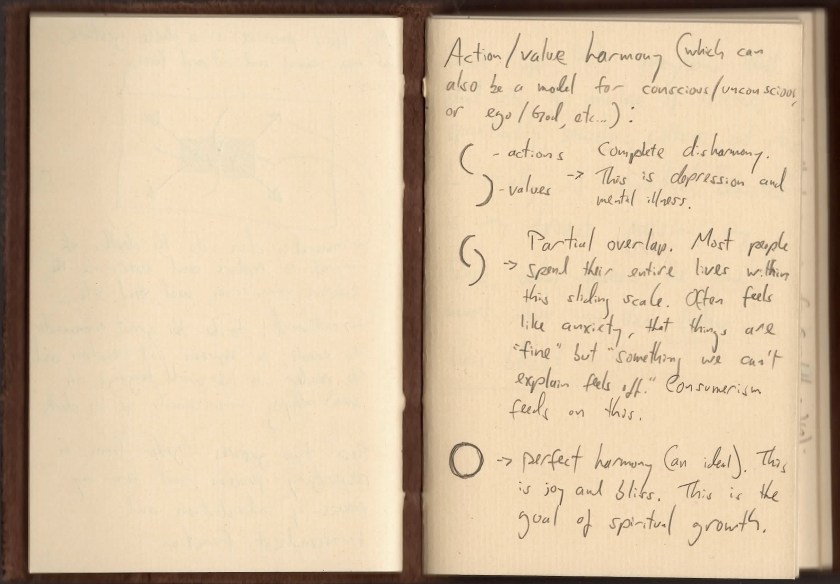
In the spirit of the New Year, of fresh beginnings, and of resolutions, I’m posting a notebook page about harmonizing “what we do in the world” with “what we believe is important.” Much of the tension I felt last year, personally, was related to this problem. Moving forward in 2015, I hope to be more mindfully aware of my core values, and then work toward finding a value/action harmony. This, of course, will be constant hard work. But if you’re up for the task, perhaps we can do it together.
For the past five years I’ve been working in advertising. I am deeply proud of the work I did and the friends I made, but something always felt a little “off” about my existence. Things were always fine and I had a lot of fun, but there was always a nagging feeling of something I can’t explain being in the wrong place. It always felt like an anxiety without referent. When I felt this way as a kid, my mother called it “being at loose ends.”
I was able to stave off this feeling by doing a lot in my limited free time. For instance, I spent three of those years writing a SciFi novel manuscript entitled Thousand Shadow on the weekends. This satisfied that feeling, but it also created a host of other problems, namely: I had to sacrifice my social and romantic life so I could write all weekend long.
Two years ago I decided to trust this feeling and follow my bliss, so I applied to PhD programs. My plan was to leave work after getting in, an easy transition from one well-established life to another. However, after getting only rejections, I faced a tough emotional crossroads. Should I continue working in advertising since I had no other immediate options, or should I trust my anxious feeling and attempt to find its source, and eventually its resolution?
With a heavy but upward-beating heart, I decided to do the latter. I quit my job and left my friends and peers with no real plan, other than to investigate this feeling. I went to a cabin in Canada for a month (with no internet and no cell phone), just me, Lake Superior, and a deep dive into my soul.
In that cabin, away from modernity, I watched my various social roles fall away, along with them their expectations and constructed desires. In this raw state, I asked myself a series of deeply personal questions, such as “What emotions do I want to feel every day?” (thanks to Scott Carson for that question), “What is most important to me?” and “What drives me to create?”
Over the following weeks, realization after realization poured out of my unconscious as I answered these questions truthfully. I’ll share two of them with you today. The first was a simple one, which is tied directly to the second. One of my questions was “What are you most excited about doing the moment you get back to civilization?” Not a long-term goal, but an immediate passion. To my surprise, the answer was: “Write a philosophy book.” I’m proud to say I’m standing by this answer, since the very website you’re now reading is this book. Acting in this way directly relates to the biggest question I asked myself:
“What are your core values?”
This might seem like an obvious question to ask (although it proves much more difficult when you attempt to answer it), so let me back up a bit to give it some context. There are two aphorisms from my friend David Lassiter that frame this question: “We’re always living out our emotional realities.” And, “We do the best we can with the information we have.”
To speak to the first aphorism, to me this means: we cannot escape our unconscious life. No matter how well paid I was or how much status my job gave me, rational and conscious thinking stands no chance against our emotional reality. If my unconscious feels conflict, then it lets me know, no matter how “inconvenient” I find it. Our emotional reality will always become manifest.
The second one means to me: don’t regret past decisions. At every moment we are doing the best we can with the information we have, meaning both external information (situational facts) and internal information (personal introspection). Our goal, then, becomes twofold: gather as much information as you can, then, do your best with it. And remember – what you do will change as new information arises, so be open.
Our core values are thus our map of the world. These values are the best map we have of what we feel true given the experiences we have had. To be emotionally and spiritually healthy, we must be aware of these values and seek to enact them in the world, relieving ourselves from internal psychological tension.
This leads me back to the above notebook page, which I’ll post again so you don’t have to scroll up.
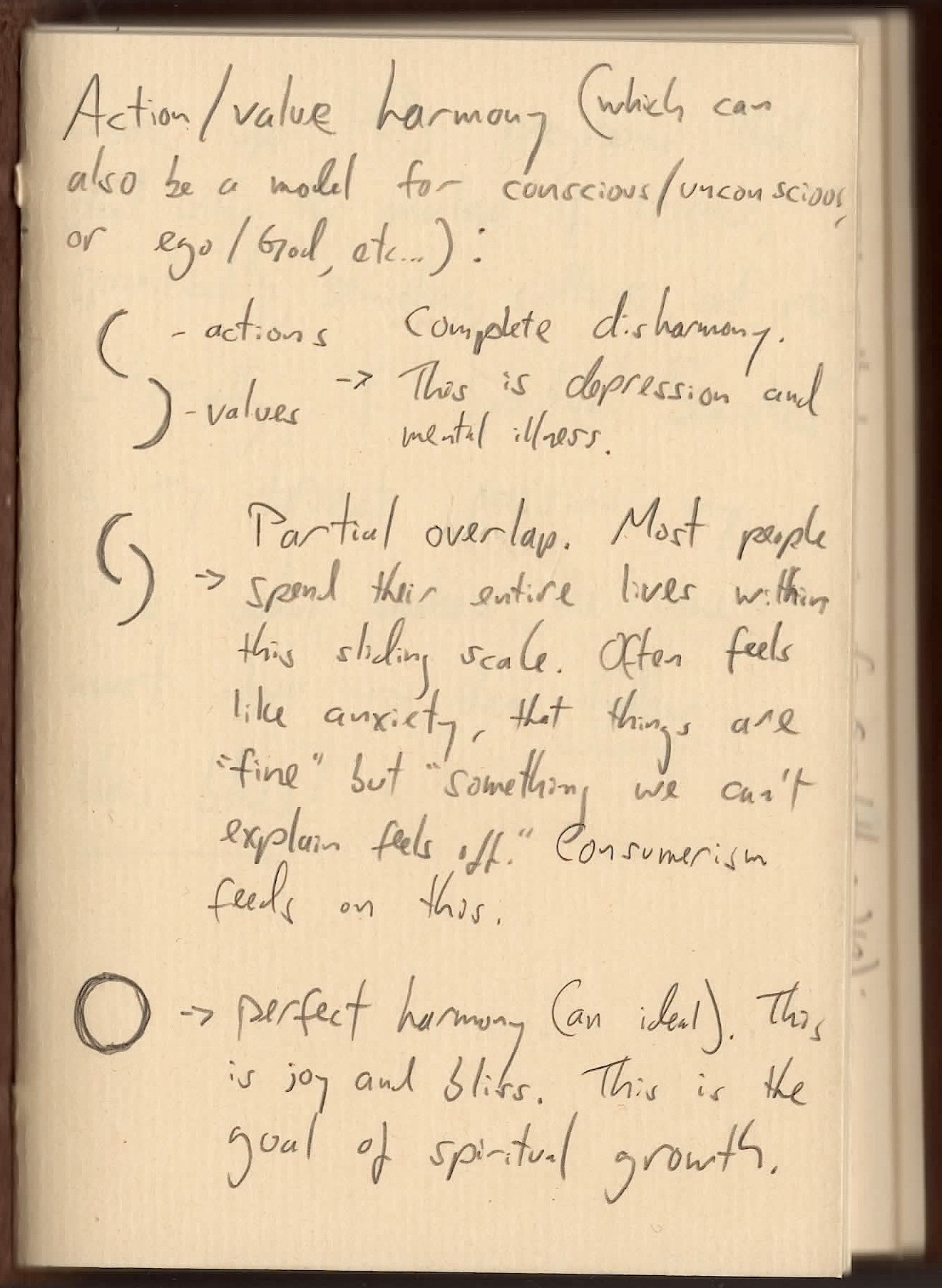
One half-circle is our “actions,” what we do in this world. The other half-circle is our “values,” our internal map of the world. If these two half-circles have no overlap at all, then we go completely crazy. This case is rare, and if our life ever gets here, we have an unmistakable feeling of “I need to get the hell outta here!” This state is painful, but clearly felt. At the other extreme, these two half-circles can perfectly harmonize, forming a complete circle. This is absolute bliss and a deep feeling of purpose in the world. Such perfect harmony is more of an ideal to strive towards rather than an actual reality. Don’t beat yourself up if you’re not there yet, I don’t think anyone is.
Most of us spend our lives in the middle. These two half-circles of values and actions are a sliding scale – sometimes in our life they are very misaligned (feelings of depression and anxiety) while at other times they are almost aligned (feelings of joy and meaning).
This middle ground is difficult, since the associated feelings are often vague. Nothing ever feels painfully wrong, usually just “fine” but persistently we are nagged by the feeling that “something we can’t explain feels off.”
Our goal in these moments is to become self-aware of our values, and then do the work we need to push our actions in the direction of harmony. Sometimes this means making drastic changes, like leaving a job or a partner. Other times it can be simpler, like deciding to volunteer on the weekends or becoming an after-school tutor. No one thing in life will give us full harmony. There is no one partner to harmonize all our values, that’s why we have friends and family. There is no one job to harmonize all our values, that’s why we have hobbies and volunteer opportunities. The goal isn’t to find some perfect fit, but to slowly and mindfully craft a whole-hearted life that “rings all our bells” so to speak.
It might go without saying, but never do something that clashes with your values. The first step is non-participation in anything you believe is evil, anywhere from not eating meat to not shopping at companies that oppose gay marriage. But always remember that life is interesting because it’s multifaceted. If your job is great but not totally fulfilling, then join a club, start volunteering, start a pop-up gallery, play with puppies, you name it. If you can’t find what you’re looking for, then create it. But if your work is literally keeping you from whole-hearted living, then make the tough decision to stand up for your values and build a life that allows for balance and diversity. (All of this is, of course, a very privileged problem to have. Privilege is not a fact to be ashamed about, but a responsibility to carry. If you are so privileged that your life can be dictated by values rather than bare political reality, then use your life to do good work for those who don’t have the historical opportunity).
There are, however, two pitfalls I want to articulate that come to light in regards to this value/action harmony model, which are closely tied together.
Firstly, we often go through our lives without proper self-examination, and thus are not consciously self-aware of our values. They’re always there in our unconscious, subtly doing work on us through intuition and feeling, but, as such, they often manifest themselves as “anxiety” when we’re doing the wrong thing. And as we know, modernity is the age of anxiety, which read differently means – the age of being unconscious of our values, and therefore doing things constantly at odds with them. But this is somewhat understandable, since articulating your core values is difficult and painful. Our society, so packed with noise and distraction, always tells us we don’t have enough time to do this work. When the truth is: we don’t have the courage for it.
Secondly, when our values are unconscious, we misattribute cause and effect. When we are doing what harmonizes with our values, we feel whole and good. However, if we’re unconscious of our values, we can easily mistake those good, harmonious feelings for effects caused by the outside “thing,” rather than landmarks of value harmony. When we think the good feelings are given to us from the outside by things, we then chase after those “things” in search of more good feelings, and often after the wrong things (and thus remain ignorant of our own changing values).
The solution to this problem is to do the hard work of spiritual introspection so that you are conscious of your core values. Once you know your core values, do your best to enact them in the world. If your actions and your values are in harmony, then you feel happiness and bliss. Don’t misattribute these good feelings to exterior things, they do not make us happy. We make ourselves happy by harmonizing our actions with our values. If something that used to make you happy no longer does, this is probably because your values have changed as you have grown older. Thus, we must be constantly looping this process back upon itself.
This process of articulating values and enacting them in the world isn’t some one-time gig. This must be a constantly looping process. This idea can be sketched in three recursive steps:
- Through rigorous introspection, articulate your core values. Make sure these values resonate with your unconscious intuition. We’re fed illusory desires all day. It will require sifting through these to realize the core of what you believe in.
- Enact those values in the world. Unhappiness comes from our values and our actions being in disharmony. Anxiety comes from half-harmony. Joy and bliss are the feelings produced when your core values are in harmony with your actions. Remember – actions don’t make us happy; we make ourselves happy by being in harmony with our values.
- As we grow and learn, our values will also grow and change. Flow with these changes. Be mindful of your heart – it’ll know. Keep doing the hard work of step #1 your whole life, and be flexible enough to always be able to make actual changes through #2.
The question remains, what are my values, and am I enacting them in the world? As I wrote in my About Me, my core values (which are very specific to me) are:
- Introspective Spirituality
- Creative Communication
- Learning through Wonder
- Love
- Purpose
- Community
- Queer Vision
- Nearness to Things
- Family
- Whole-Hearted Living
- Playful Joy
- Athletic Embodiment
- Kindness
- Discipline
Finally, how am I enacting these values in the world? Live The Questions and this book are my largest gestures of attempting to find action/value harmony. I am re-applying to PhD programs for a second time. And from there, we shall see what 2015, the new year, brings.
 Live The Questions